
Stuck in the Mud: What Life and Research in the Okavango Delta Teach Us About Wetlands

Updated: Feb 3
In honour of World Wetlands Day
We were searching for Mason, a collared male lion that usually roams near Xini Lagoon in the Moremi Game Reserve. We hadn’t seen him in some time, and our research protocol required us to locate him and download data from his GPS collar. When his signal finally appeared, we left the main track and drove off-road toward the steady beep.
Recent heavy rains had transformed the landscape. Tall grass concealed the ground, making it impossible to distinguish firm soil from deep mud. Sitting on the centre console to improve my view, I carefully picked a path until one wrong turn around an acacia shrub sent the wheel sinking fast. I engaged low-range and locked the differential, but instead of reversing, the vehicle dug itself even deeper.
We were stuck!

After nearly two hours of digging, lifting, and wedging logs under the tyres, we made no progress. Our second vehicle was only 500 metres away, so we walked back to retrieve it. Halfway there, the sky opened, and rain poured down, soaking us within minutes. When we reached the vehicle and attempted to reverse, it sank immediately.
Now both vehicles were stuck, and for the first time, the situation truly felt heavy. Stepping out into the wet grass, we paused, took a breath, and returned to work. Lifting, digging, and stacking logs once more. After hours of effort, one vehicle finally broke free. We cheered briefly: one rescued, one to go. Moments later, while reversing to avoid a blocking tree, the freed vehicle sank again. Within seconds, excitement turned into pure frustration.
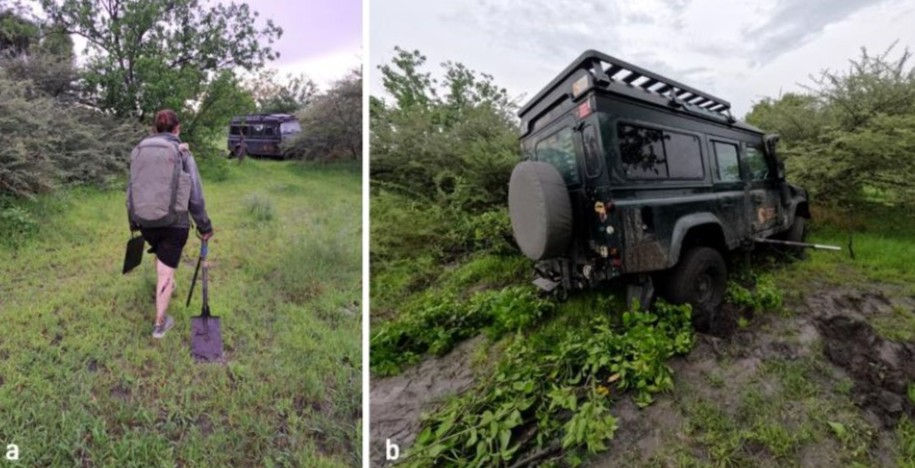
Water is both a lifeline and a barrier in the Okavango Delta. It shapes dispersal routes, determines habitat availability, and governs connectivity between wildlife populations. Thanks to the Delta’s remarkable seasonal dynamics, landscapes change constantly, altering conditions from one day to the next.

By late afternoon, it was clear we wouldn’t escape that day. Overnight, more than 70 mm of rain fell. By morning, the grassland had transformed into a wetland. Pulling on soaking shoes, we jumped back into the mud and resumed digging. Our rescue finally arrived at the sound of a familiar Land Rover engine. Peter Brack, our hero, had received our SPOT message and came to help. One vehicle was carefully pulled free, then the other, after scouting a safe route on foot.
Driving back to camp, we passed a tourist vehicle stuck nose-deep in water. This time, it was our turn to help.
Water as the Architect of Movement
Today, satellite imagery allows us to track floods and seasonal pans across the Okavango Delta. By overlaying water dynamics with carnivore movement data, we can see just how dramatically dispersal ability changes with flood levels. In low-flood years, wild dogs may traverse from the eastern Delta to the west. During peak floods, such movements become impossible (Hofmann et al. 2024).
Why the Okavango Delta Matters
The Okavango Delta is one of the world’s great wetlands: a Ramsar site of global importance and the largest inland delta on Earth. At peak flood, it spreads across up to 15,000 km², sustaining human livelihoods and extraordinary biodiversity, including more than 1,000 plant species and hundreds of bird, fish, and mammal species.
What defines the Delta most, however, is its constant change. Its pulse is driven by two distinct water rhythms. First, local rains briefly turn floodplains green. Months later, floodwaters arrive from the Angolan highlands, spilling slowly through channels and plains that have already begun to dry. In a landscape so flat that a few centimetres determine flow direction, small shifts can redirect water for kilometres. The Delta is always moving.

Research in a Shifting Wetland
Conducting large carnivore research in the Okavango Delta is an expedition across a shifting landscape. The Botswana Predator Conservation (BPC) study area spans roughly 3,500 km², much of it seasonally inaccessible. Each day begins with a plan, and almost every day that plan changes.
Water determines where we can go, how long it takes, and whether certain areas are reachable at all. Rivers like the Gomoti may be passable one week and impassable the next, forcing us to adapt constantly, by foot, mokoro, or even aerial surveys.
A decade of studying dispersing carnivores in the Delta has taught us one thing: besides human settlement, water is among the most influential forces shaping wildlife movement (Hofmann et al. 2021; 2023). Seasonal floods shrink available space, forcing lions, wild dogs, and other predators into closer competition. Entire groups may become isolated on islands for days or weeks. Carnivores rarely cross water unless absolutely necessary, the risks, from crocodiles to hippos, are high.
Water does not merely move through the landscape; it reshapes connectivity across habitats, protected areas, and even national borders. This connectivity pulses with the floods, contracting and expanding as animals adapt to a dynamic, ever-changing wetland system (Hofmann et al. 2024).

A Global Stronghold Under Pressure
The Okavango Delta is Botswana’s wetland—and a global stronghold for biodiversity. It supports wattled cranes (vulnerable), several vulture species (some critically endangered), cheetahs (vulnerable), and African wild dogs (endangered), many in globally significant numbers. A glance at the IUCN Red List reveals just how pivotal this ecosystem is.
Its role as a reservoir of species richness—and as a source population for surrounding regions—cannot be overstated. Conducting research in this extraordinary wetland is a privilege and a reminder of how finely balanced life here truly is.
Climate change adds new uncertainty. Rainfall patterns in Angola, evaporation across the Delta, upstream water use, and subtle topography interact in complex ways that make future floods increasingly difficult to predict. What is clear is that variability is increasing: heavier rains, stronger floods, and longer dry periods.
In such a system, small changes can have outsized consequences.
Why World Wetlands Day Matters
Back at Dog Camp, washing away the mud, we looked out across grasslands that once flooded seasonally. Channels have shifted. Species assemblages have changed. What was once a wetland is now drier ground, sustained by artificial waterholes. The Delta has always been dynamic, but the pace of change is accelerating.
Even here, in one of the world’s last great wild places, the Okavango continues to rewrite its own story. World Wetlands Day reminds us that wetlands are not static landscapes, but living, moving ecosystems that we must understand, respect, and protect as they change.

References


Comments