
TIGERS AND LEOPARDS IN NEPAL: WIDENING SCOPE FOR BIOBOUNDARY PREDATOR DETERRENTS

Peter Apps, BioBoundary Project, Botswana Predator Conservation, Wild Entrust
All over the world, the survival and recovery of predator populations are threatened by lethal control in response to predator attacks on livestock and people. Paradoxically, when successful conservation increases predator numbers, this Human-Wildlife Conflict intensifies.
Nepal faces just such a challenge; her tiger population has more than tripled since 2010, and as their numbers increased, more of the striped cats moved out of national parks and into buffer zones and community forests, where rural people herd their livestock, cut timber, and harvest fruit and other wild foods. The increasing number of tigers in the wildlife areas and buffer zones also pushed leopards further out into community forests and surrounding agricultural areas, and into the fringes of villages and the suburbs of towns and cities. In these densely settled areas, there is less natural prey for the leopards to eat, and so they increasingly prey on livestock and domestic dogs. Inevitably, as more people share space with more wildlife, conflict incidents become more frequent.

Community forests in Nepal's Khata corridor are habitat for leopards and sources of renewable resources for people.
Protecting people and their livestock from predators without jeopardising predator populations requires measures that are non-lethal, minimally invasive, low-tech and low cost, and ecologically benign, with the minimum of effects on other species, including people. None of the measures currently in use meet all of these criteria, but radically innovative research by Botswana NGO Wild Entrust Africa has shown that releasing artificial equivalents of the odorous compounds in predators’ scent-marks stops predators from attacking livestock, and in turn protects the predators from lethal control.
Now, Wild Entrust’s BioBoundary Project is expanding the application of its wild scent deterrents to tigers, leopards and snow leopards in Nepal. In a multinational collaboration with Cornell K. Lisa Yang Center for Wildlife Health, WWF Nepal, Nepal’s Department of Forests and Soil Conservation, and the Terai Arc Landscape Programme, with funding from the Cornell Feline Health Centre, the responses of tigers and leopards to potential deterrents are being tested in the community forests of Nepal’s Khata Corridor, close to Bardia National Park.
Dr Peter Apps from Wild Entrust’s Botswana Predator Conservation Program and Dr Martin Gilbert from Cornell University, trained teams of Nepali citizen scientists to set up BioBoundary testing stations along tracks and trails through the forests, where pairs of dispensers release the deterrents at rates of a few millionths of a gram per hour, and predators’ reactions are monitored by automated camera traps that capture 20-second video clips when they are triggered by passing animals.

The Nepali citizen scientist teams with Martin Gilbert (kneeling left of the tree), Samundra Subba, WWF Nepal (standing left of the tree) and Peter Apps (standing right of the tree).
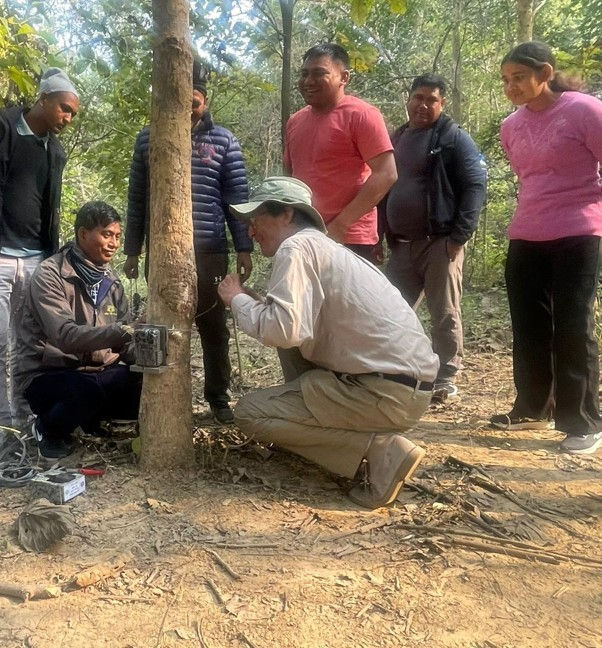
Peter Apps demonstrating to Nepali citizen scientists the camera trap set up used to monitor how predators react to potential deterrents.

Scent dispensers in protective metal housings were stationed on both sides of forest tracks so that wind from any direction would carry scent across the track.

Predator reactions to potential deterrents were monitored with camera traps.
The Nepal project has already generated its first positive results. Compounds that are useful repellents reduce the number of videos that the cameras capture, and two compounds that we tested reduced the number of tiger videos, and three reduced the number of leopards . One compound, which also repelled captive leopards in South Africa, repelled both species in Nepal.

A leopard passes a camera trap on a forest path in the Khata corridor.

At midday in a community forest, a tiger walks along a road that is also used by people.
Even more exciting, are video sequences of tigers reacting to two of the artificial scent signals as if they were natural scent-marks. One tiger intently sniffed a scent dispenser, and pawed at its stake, then intently sniffed the other dispenser and turned back the way he had come – watch the video at https://youtu.be/6wInRkUc4Bk . Another tiger made a U-turn after repeatedly sniffing the two dispensers - https://youtu.be/zLlGz74NUqk . These are behaviours we expect when a tiger encounters another tiger’s territorial scent-marks.

A tiger paws at the stem of a dispensers that is releasing the odour of a components of predator scent-marks. The full video is at https://youtu.be/6wInRkUc4Bk
Another scent lured tigers into approaching and carefully sniffing the dispensers -https://youtu.be/ImEEzLkzITE https://youtu.be/dqyLeink79c ; a tigress walked past a scent dispenser, turned back on her tracks, sniffed both dispensers intently, and then continued in the original direction.
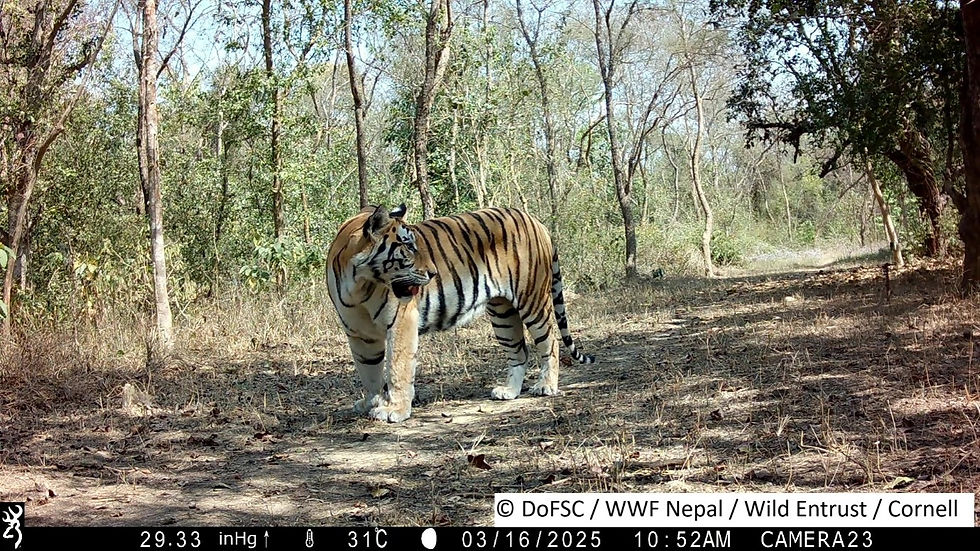
A tigress stops before walking back to the scent dispensers. The full video is at https://youtu.be/dqyLeink79c
These results in Nepal build on the BioBoundary’s successes in Botswana, where scent-based deterrents reduce leopard predation on livestock and keep predators out of livestock areas; https://www.wildentrust.org/post/goats-do-roam-a-new-bioboundary-experiment-makes-it-safe-for-them-to-do-so , https://www.wildentrust.org/post/communicating-with-african-wild-dogs-using-bioboundary-chemical-signals . https://www.wildentrust.org/post/bioboundary-predator-repellents-doing-impossible-things , results that we plan to replicate in Nepal.
Donor support will be critical for us to continue our development of scent-based tiger and leopard deterrents as innovative, practical, low cost, non-lethal tools to protect livestock, keep people safe from attacks by big cats, and help secure Nepal’s recovering big-cat populations.


Comments